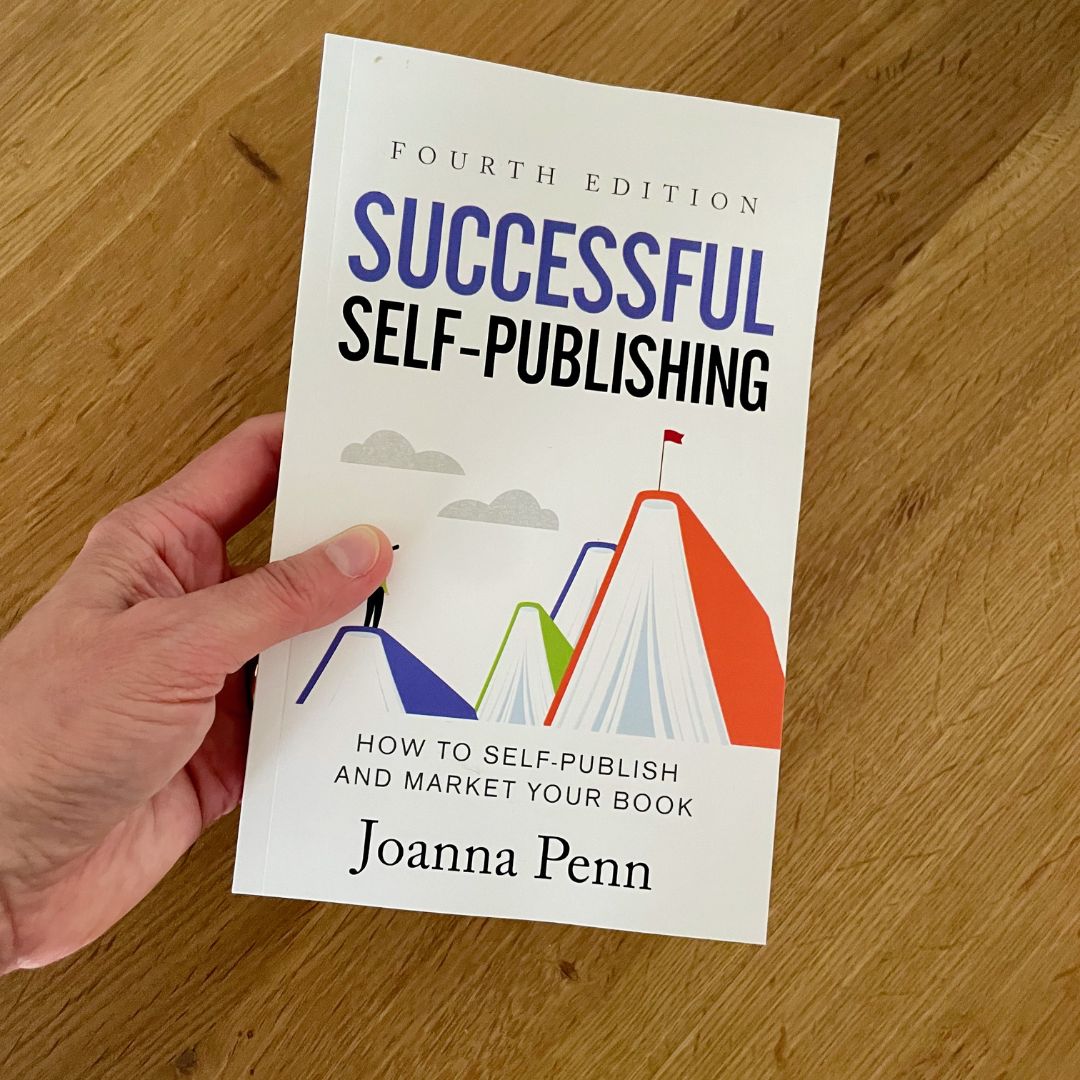
Successful Self-Publishing: The artisan author in an age of AI
When I started self-publishing almost two decades ago, the indie revolution was just beginning to rise on the back of new technology. 2007 saw the launch of the Amazon Kindle and the Apple iPhone as well as ebooks, digital audio, and print-on-demand.
It was also the early years of Facebook and Twitter, as well as blogging and podcasting, so authors were able to reach readers all over the world with online marketing and break free from traditional media channels.
It was a time of disruption, and many in publishing resisted the shift, saying that ebooks would never take off, that self-publishing platforms were just vanity presses for failed authors, and that social media and mobile commerce were just fads. Technology takes time to get wider adoption, and I even remember saying to my husband Jonathan that I would never get an iPhone, as I was happy with my little Nokia. I only needed to text after all, so I didn’t need any of those app things!
But as I explored these tools, I became increasingly excited as I realized that technology was going to help me achieve my creative and financial goals, and that I could surf the wave of change into a new career as an indie author.
I’ve been feeling the same excitement in the last few years as the rise of generative AI has expanded our options even more. The tools amplify my abilities, augment my creativity, and extend what I’m capable of. I laugh more when I collaborate with ChatGPT and Claude, I’m in a state of flow more often, and my creative spark is fired up even more.
However, the use of AI tools continues to be a polarizing topic within the author community, and that’s understandable. The companies who developed generative AI tools are relying on a fair-use argument for original training on copyright data. This is being challenged in various court cases in several jurisdictions, but even if the eventual outcome leads to some kind of settlement, these tools are here to stay.
To be clear, you don’t need to use AI tools to be a successful self-published author —everyone must make their own choice — but if you’re even a little AI-curious, read on.
The AI-Assisted Artisan Author (A4)
In May 2023, I introduced the concept of the AI-Assisted Artisan Author (A4) on my site, The Creative Penn, and it remains my guiding principle.
While you can now use AI tools to generate a book a day with AI covers, AI narration, and AI translation into multiple languages, that is not something I’m interested in doing.
Being an artisan author is about bringing intentional craftsmanship to every aspect of your work. You create books that come from your ideas and story seeds, that are written in your voice, that you edit and refine until you’re happy with the result. You work with AI tools along the way, but only in service to your creative vision and at your direction. They are collaborative tools, but you drive them, and every creative decision is yours.
An artisan author focuses on the personal touch, leaving ‘handprints’ as tech journalist Kevin Roose says in his book, Futureproof: 9 Rules for Humans in the Age of Automation.
The metaphor is based on pottery, comparing a mass-produced factory mug that is perfectly functional, exactly the same as the others, that you buy cheaply for a specific use, and that of an artisan potter, whose work might be imperfect but has more personality, and perhaps even has a thumbprint left in the clay.
The latest AI models can generate many thousands of well-written words every day, but as authors who care about our own creative work, we’re not competing on the speed of output. You cannot compete with the machines. They will only get better and faster.
But that’s okay, because you don’t need to.
Double down on being human and focus on what no machine can ever replicate. Being you.
Guidelines for AI usage
At the time of writing, there are outstanding legal cases around whether training AI models on copyright works is allowable under the legal principle of fair use. But however this is eventually resolved, the AI tools are not going away, so authors and the publishing industry — as well as other industries — are now finding ways to use the tools in an acceptable manner.
Wiley was one of the first traditional publishers to release guidelines for authors using AI in early 2025: “Wiley welcomes the thoughtful use of AI tools. When used responsibly, authors can maintain high editorial standards, safeguard intellectual property and other rights, and foster transparency with readers.”
Their extensive guidelines, prepared in collaboration with AI tools ChatGPT and Claude, go into all kinds of ways authors can use AI tools, without using them for the final publishable words of a manuscript. They provide suggestions for how to use AI tools for familiar steps of the writing process, like research and analysis, content development, review and editing, and marketing. They also provide guidance on new considerations that come with these tools, such as effective prompting, safe and responsible use, quality and fact checking, dealing with hallucinations, copyright concerns, image use, disclosures, and more.
In summary, they say,
Authors may only use AI Technology as a companion to their writing process, not a replacement. As always, authors must take full responsibility for the accuracy of all content, and verify that all claims, citations, and analyses align with their expertise and research. Before including AI-generated content in their Material, authors must carefully review it to ensure the final work reflects their expertise, voice, and originality while adhering to Wiley’s ethical and editorial standards.
Given that these guidelines are from a respected traditional publisher, this should give authors some comfort about where the lines are being drawn.
The Alliance of Independent Authors (ALLi) also has guidelines for ethical AI usage, which state, “ALLi supports the use of AI as a tool for ethical creators, not as a creator itself.”
The guidelines explore the various issues and controversies around AI but also say, “ALLi recommends that authors bring a spirit of curiosity to their consideration of AI, and be willing to explore the potential of AI in their work as writers and publishers.”
As an independent author, you get to decide where your lines are and what you’re comfortable using. You don’t have to use AI tools for anything, or you can go all in, or fall somewhere in between, as I do.
Copyright
In terms of copyright, check your jurisdiction for what applies.
In the United States, the Copyright Office will not register material generated entirely by an algorithm, because it lacks the necessary “human authorship.” Portions that you curate, edit, or meaningfully arrange may still qualify, but you must document your contribution and describe it when you file the registration.
In the United Kingdom, section 9(3) of the Copyright, Designs and Patents Act 1988 recognizes “computer-generated works” and the right belongs to “the person by whom the arrangements necessary for the creation of the work are undertaken,” the prompter or project lead.
Essentially, if you are AI-assisted, using AI tools as part of your process, then your work remains your copyright. If you prompt and publish, this is AI-generation, rather than assistance, and is not your copyright, at least under current US law.
I had an in-depth conversation with attorney and author Alicia Wright on this topic on The Creative Penn Podcast, which you can find at: www.TheCreativePenn.com/fairuse.
Disclosure and labelling
Disclosing your use of AI is a personal choice, except where platforms require it as part of their terms of service, like Amazon KDP and Kickstarter. I have always been open about my usage as an AI-assisted artisan author, and I’m glad that more authors and publishers are embracing this approach. After all, I see no reason not to be honest about ethical use of the AI tools.
I first became interested in the impact of AI for writers in early 2016 when AlphaGo beat Lee Sodol at the Chinese game of Go. Move thirty-seven was considered “creative,” and the game has subsequently been transformed with human and AI collaboration.
In 2020, I wrote a book on the topic, Artificial Intelligence, Blockchain, and Virtual Worlds: The Impact of Converging Technologies on Authors and the Publishing Industry, and much of what I discussed there is only now being discussed in the mainstream.
I’ve interviewed AI experts on The Creative Penn Podcast for years, as well as doing solo episodes on how I’m using AI. I also share tutorials and insights within my Community at Patreon.com/thecreativepenn.
I’ve been open and honest about my usage of AI tools, including disclosures on my books and copyright notification for images, and I’ve always labeled my AI-narrated audiobooks on the cover as well as in the description.
When Amazon KDP introduced disclosure of usage, I even went back and updated my old books. I’m always happy to disclose my usage because I use AI to assist, enhance, and augment my creative work. I don’t prompt, generate, and publish.
Many authors are worried about AI-related hate, which mainly comes from other creators, rather than readers. I’ve certainly had my share of this, and it ebbs and flows over time. This is nothing new and always happens in times of technological change.
In the early days of digital self-publishing, indie authors were ridiculed, shamed, and put down. We were told our work was inferior, that we were inferior. That our books were a “tsunami of crap” that would overwhelm the publishing industry. That we should all stop writing, stop publishing, and leave books to the ‘real’ authors, those chosen by agents and publishers.
But those days passed, and now self-publishing is (mostly) recognized as a creative choice and a valid business model. The days of ‘us’ versus ‘them’ shifted as the publishing lines blurred, and many authors moved into a hybrid model, licensing some rights to publishers, while going indie for other books and formats.
This shift has started for AI usage in recent months as even the most basic tools like Microsoft Word and Google Docs incorporate aspects of AI, and publishers, author organizations, and creators demonstrate ways to use it ethically and responsibly to create better books and expand marketing capabilities.
Double down on being human
While I clearly embrace the responsible use of AI tools as part of my creative process and my author business, I absolutely recognize that an unchecked flood of AI-generated books and other content represents a threat to human authors. The quality of the models and the standard of writing and storytelling improves every month, so these books will no doubt be objectively ‘better’ than many human-written books at some point.
But that doesn’t matter.
I am not competing with the machines, or those who use the machines to generate to market. I am a flawed human with lots of ideas and strange quirks and things I want to make in the world. I am a creator and I am just going to keep creating!
I’m also going to use my humanity in my work and my marketing, and I recommend you do as well. Here are some ideas.
Show your face or your voice as much as you can, as body language, voice intonation, and the elements of how you communicate physically are part of what makes you human.
Be more personal in your emails, social media, and with your community. Write more naturally, share pictures of yourself, your garden or your cats, or whatever is personal to you but still gives you enough of a boundary. Give people an insight into aspects of your human life beyond your words.
Make beautiful books and physical products. Authors and publishers who generate to market won’t be spending the time, effort, and money creating artisanal books. Special signed hardbacks with sprayed edges, photos from your research, custom end papers, and other unique products will help you stand out in a flood of digital-only books and audio.
Include an author’s note. As a reader, I love finding an author’s note at the end of a novel and as a writer, I’ve always included them in my fiction. I think they’re even more important now in an age of AI. Talk about why you wrote the book, why it’s so personal for you, and give readers an insight into you and what you care about as a human.
You can find more details in my video and article at: www.TheCreativePenn.com/doubledown
* * *
The rise of generative AI tools doesn’t mean the end of human creativity. It’s more like a new beginning, in the same way as computers and the internet changed the way we write, publish, and market our work over the last twenty years.
By embracing the artisan mindset, we can use the tools to create more meaningful and beautiful books, build stronger connections with readers, and develop sustainable author businesses that support our creative vision.
Creators who blend the efficiency and opportunities of technology with the human elements of creativity, empathy, and lived experience will be successful artisan authors in the age of AI.
As Professor Ethan Mollick notes in his book Co-Intelligence, “As artificial intelligence proliferates, users who intimately understand the nuances, limitations, and abilities of AI tools are uniquely positioned to unlock AI’s full innovative potential.”
I believe this is the most exciting time in history to be an independent author. We have unprecedented creative tools at our fingertips and more ways than ever to reach readers who will love our work. The key is approaching these tools with intention, curiosity, and a commitment to our own craft and creative vision.
I intend to surf this next wave of technological change into success in the years ahead. I hope you will join me, and in the next chapter, I’ll go into some specific ideas for how you can use AI tools to help.
Resources:
• My enthusiastic YouTube video about the International Kindle from October 2009, before Amazon KDP was open to international authors — www.TheCreativePenn.com/kindle2009
• The AI-Assisted Artisan Author with Joanna Penn, 5 May 2023 — www.TheCreativePenn.com/a4
• Futureproof: 9 Rules for Humans in the Age of Automation — Kevin Roose
• Co-Intelligence: Living and Working with AI — Ethan Mollick
• Wiley publishing guide to using AI tools in your writing, accessed 29 April 2025 — www.wiley.com/en-gb/publish/book/ai-guidelines
• AI for Authors: Ethical & Practical Guidelines from the Alliance of Independent Authors — selfpublishingadvice.org/ai-for-authors-guidelines
• US Copyright Office guidelines for AI — www.copyright.gov/ai
• UK Copyright, Designs and Patents Act 1988 — www.legislation.gov.uk/ukpga/1988/48/section/9
• Fair Use, Copyright, and Licensing. AI and the Author Business with Alicia Wright — www.TheCreativePenn.com/fairuse
• In Two Moves, AlphaGo and Lee Sodol Redefined the Future, WIRED Magazine, 16 March 2016, accessed 29 April 2025 — www.wired.com/2016/03/two-moves-alphago-lee-sedol-redefined-future
• Artificial Intelligence, Blockchain, and Virtual Worlds: The Impact of Converging Technologies on Authors and the Publishing Industry — Joanna Penn
• Amazon KDP Help on AI usage disclosure — www.TheCreativePenn.com/ai-kdp
• Kickstarter AI disclosure — updates.kickstarter.com/introducing-our-new-ai-policy
• The tsunami of crap, J.A. Konrath, 5 July 2011, accessed 29 April 2025 — jakonrath.blogspot.com/2011/07/tsunami-of-crap.html
• How to Double Down on Being Human: 5 Ways to Stand Out in an Age of AI — www.TheCreativePenn.com/doubledown
• My author community around writing craft, author business, and creative uses of AI — www.patreon.com/thecreativepenn