
Writing the Shadow: Stop self-censoring
“I want to stand as close to the edge as I can without going over. Out on the edge you see all the kinds of things you can’t see from the center… Big, undreamed-of things.”
—Kurt Vonnegut, Player Piano
Self-censorship is a natural response to the pressures we face as writers and as humans in this increasingly noisy world. Every day we’re bombarded by other people telling us what it’s okay to think, and therefore to write.
Societal norms and expectations constrain us, news media headlines make us want to conform for fear of judgment, and social media rewards us by responding to the ‘likes’ of the crowd.
But when you censor your ideas before you have even written them, you are letting fear of judgment, fear of rejection, and fear of backlash from an imaginary audience stop you.
Your thoughts are nothing until you put them onto the page, and what emerges in writing is often completely different from what you thought it might be in your head.
If you censor yourself before you even get to the blank page, you may never discover the edge, or the “big, undreamed-of things” that Vonnegut spoke of. You may never find your gold.
Does your inner critic come from the Shadow?
You can’t think that.
You can’t write that.
You can’t imagine those things.
Who do you think you are?
You don’t have permission to write that, to think that, to publish that. To be that person.
We all have an inner critic, a voice that says we are not good enough, that an idea is terrible or has been written before, that our words are worthless. Perhaps the voice of your inner critic comes from something in the Shadow? As I recounted earlier in Chapter 2.2, it was the criticism of a teacher early in my life that made me think I couldn’t write in a certain way.
So how do we stop self-censoring to write what we really want to? Here are some ideas.
(1) Don’t tell anyone you’re writing
If you write as if no one will ever read your words, you might be able to sidestep self-censorship.
Your creativity is a fragile seed at the beginning of every book, and even more so at the beginning of your author career. When the fresh green shoots emerge above the surface, they are easily bruised and broken, stamped upon by others, or can die from lack of care.
Sometimes it’s best to keep your writing secret so you can protect your little seedling until it is strong enough, with roots that go deep enough, to weather the treatment it will have to face. In this way, there are no expectations hanging over you, no pre-judgments restricting your growth.
(2) Change your physical location when writing
The places where you live and visit regularly become part of your routine. You also perform certain roles in your home or place of work.
If you want to break out of the expectations of those roles, then find a new place to write.
Break yourself out of your comfort zone.
Try a new coffee shop or write in your car overlooking a new setting, or sit at a new desk facing the opposite way at the library.
If you must be at home, change the atmosphere. Listen to a new playlist, sit somewhere different, or light a candle with an unusual scent. Anything to make the experience distinct enough from how you usually create.
(3) Write another book
I’ve found that the easiest way to deal with fear of judgment around a particular book is to write another. Partly because I grow more confident as an author with every book, so I’m more secure in my creative expression. Partly because the emotional attachment to a book, and how much we identify ourselves with it, lessens when focusing on a new project, and fades even further with the distance of time.
We change with every book we write.
We transform through our creative work and with each book, we can push our boundaries a little more.
Poet Stephanie Wytovich delved into this form of progress in an interview on The Creative Penn Podcast:
“If we can find a way to acknowledge our lines, or acknowledge where we put our boundaries, and then start having conversations with ourselves about why those boundaries are there, what those boundaries are protecting us from, and then slowly start inching over them in our writing, I tend to think that that’s where the gold usually lies.”
(4) Surround yourself with people who understand
Let’s face it, writers are weird!
We spend a lot of time in the strange corners of our imagination, musing about random ideas, talking to characters we made up. If you’re like me, you might be blowing things up and killing people and creating mayhem and destruction — on the page, of course.
If you externalise these thoughts around the wrong people, they will judge you for it, and their reaction may shut you down.
It’s a hard truth, but our family and friends — those who love us in our ‘normal’ life — are often the least interested in our books. They are not our ideal readers, as much as we think they should be interested, so let them be.
Instead, find a supportive community of like-minded weirdos, and your creativity will flourish.
Investigate communities around your genre. I’m a member of the International Thriller Writers and also the Horror Writers Association, and I find both to be full of welcoming writers who don’t find me weird at all. Such a relief!
You can also find groups around your publishing choices. I’m a member of the Alliance of Independent Authors as well as the Society of Authors.
There are plenty of Facebook groups around genre-specific topics, and for writers at every stage of their career.
None of these are perfect. People are people, and groups and organisations also have their Shadow side, but if you spend some time actively looking, you will find a supportive community somewhere.
(5) Use a pseudonym
Pseudonyms, or an alias or fake name, have often been used to shield authors from judgment or prejudice, or to separate brands based on audience expectations.
Since women could not publish in the nineteenth century, the Brontë sisters published their first collection of poetry together under male names. Emily’s Wuthering Heights and Charlotte’s Jane Eyre were also originally published under male names.
Louisa May Alcott, author of the tame and societally acceptable Little Women, also published “blood and thunder tales,” under A.M. Barnard. Stephanie Sylverne, in an article on CrimeReads, notes, “This was the work Alcott was passionate about before the financial needs of her family forced her into writing what she called ‘moral pap for the young.’”
Using a different name can also help keep your writing self separate from you as an individual. It can give you a layer of protection to prevent people in your normal life associating you with your writing.
Authors who are also medical doctors, lawyers, police officers, and others have used pseudonyms to protect their professional reputation.
Many erotica authors use different names. For example, Erika Mitchell wrote Fifty Shades of Grey as E.L. James.
Writing under a pseudonym can also be a way to expand into other genres without impacting your existing reputation or confusing or offending your audience. It can help you escape the confines of an established brand and become more creatively free.
Mystery writer Agatha Christie wrote other types of novels under the name Mary Westmacott, exploring what one biographer called “her most private and precious imaginative garden,” while she was best known for her more formulaic murder mysteries.
J.K. Rowling writes much darker crime novels as Robert Galbraith to escape the Harry Potter fantasy expectations of her original readers.
I write under two names, but it’s been a complicated process.
My full name is Joanna Frances Penn, but family and friends have always called me Jo. When I started writing, I wanted a professional name, but I was told that many Americans considered ‘Jo’ to be a man’s name, so I published under Joanna Penn.
I wrote several non-fiction books and my first couple of novels under Joanna Penn, but then I realised that this cross-genre writing was confusing to my readers and muddied my non-fiction brand.
Originally, I had everyone on the same email list, which was hard to manage, and it messed up the algorithm-driven, also-bought lists on the online retailers. In addition, I received several reviews from readers saying that they “were surprised a woman had written this,” and I didn’t want to be pre-judged for my gender.
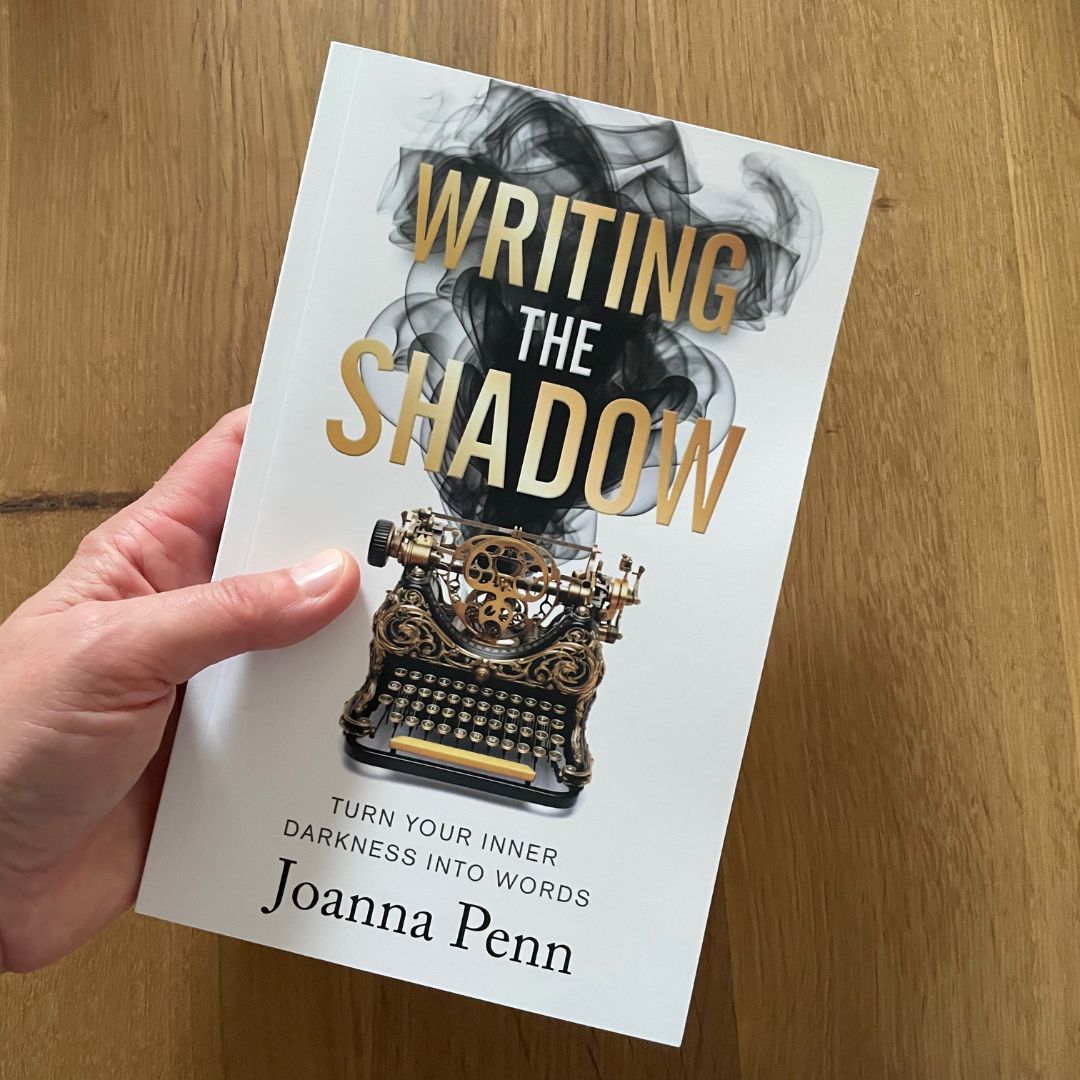
So, I split out my fiction under J.F. Penn, and the use of gender-neutral initials is a common choice for authors. I’ve also found it helpful creatively as I’m a different writer as J.F. than I am as Joanna Penn. This book straddles both of my author personas, but it is at heart a self-help manual for writers, hence it’s under Joanna Penn.
It’s certainly more effort to run two author brands, but it’s helped me to explore my Shadow and focus on distinct audiences. Only you can decide what’s best for your creativity and your author career.
Questions:
• How do you self-censor? How do you stop yourself from writing what you really want to?
• What does your inner critic say about you and your writing?
• Where does your inner critic come from?
• How can you bypass your inner critic, especially while you’re writing your first draft?
• If you had no constraints, no fear of what others might think, what would you write?
• How might things change if you wrote in secret?
• Where do you write at the moment? Is that place associated with a specific role or expectations that might be constraining you?
• How might writing in a new place liberate you?
• Do you have a community of like-minded creatives? If not, where might you find them?
• How might a pseudonym help you write what you really want to?
• What are the pros and cons of pseudonyms?
Resources:
• Agatha Christie: A Mysterious Life — Laura Thompson
• “Louisa May Alcott’s Forgotten Thrillers are Revolutionary Examples of Early Feminism,” Stephanie Sylverne, CrimeReads, November 22, 2019 — www.crimereads.com/louisa-may-alcotts-thrillers
• Writing Poetry in the Dark with Stephanie M. Wytovich — www.TheCreativePenn.com/wytovich